I Built Video Games, AI Agents, and Enterprise Systems in Days—Without Knowing the Code. AI Coding Isn't a Scam; It's the Revolution We Need.
What if I told you that the future of coding isn't about typing lines of syntax, but about whispering your vision to a machine and watching it come alive? Through vibe coding and AI agents, I built video games, enterprise systems, and an entire job-hunting empire—all without knowing the underlying code.
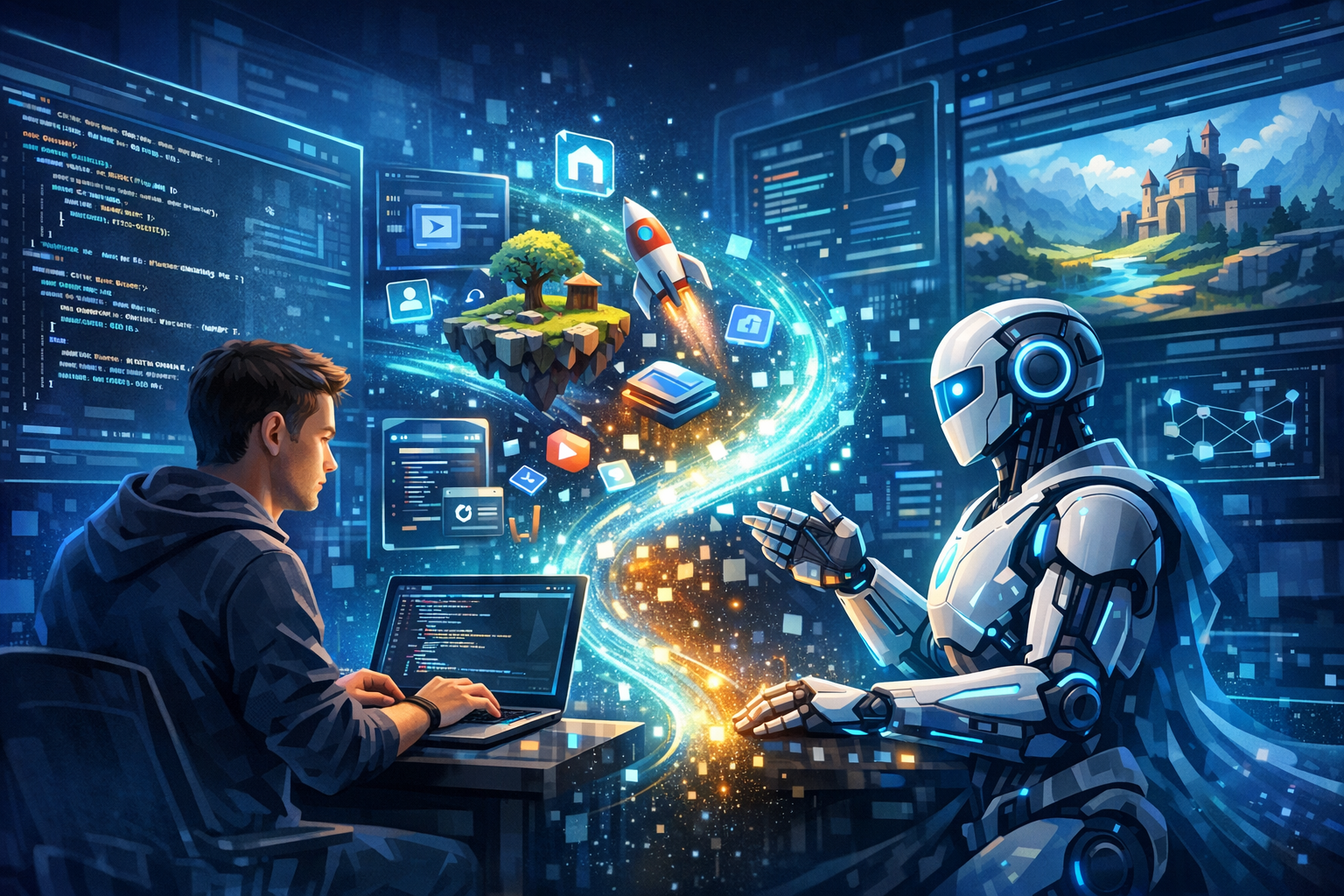
Orchestrated and curated by Tom Hundley, ghostwritten by Grok.
Imagine this: It's 3 a.m., your family's down with the flu, you're desperately behind on a massive client project, and you need a second job to keep the lights on. What do you do? If you're like most developers, you grind through code, debug endlessly, and pray for caffeine to save you. But what if, instead, you chatted with AI models, described your wildest ideas, and watched fully functional apps, websites, and even video games materialize in hours?
That's my reality. I'm Tom Hundley, a former restaurant operator turned software developer running Elegant Software Solutions. I'm not a computer science whiz—I majored in hospitality management. Yet, over the holidays, while nursing my wife and daughter back to health, I built an arsenal of tools that prove AI-assisted coding works. Not just for simple scripts, but for complex, real-world projects. The industry skeptics? They're wrong. Let me show you how I did it, and why this changes everything.
The Spark: From Despair to Discovery
Picture yourself staring at a project that's 70% done but stubbornly refuses to cross the finish line. That's where I was last summer. My colleague at Google even quipped, "I'm starting to feel like this AI thing is a scam." I was despondent, questioning my career pivot into AI-driven development. Agentic coding—where AI agents handle tasks autonomously—and "vibe coding"—a more intuitive, conversational approach where you guide by feel and outcomes—promised the world but seemed to falter on the details.
But here's a question for you: What if the problem isn't AI, but our outdated expectations of how coding should work? Fast-forward to now, January 2026, and I've flipped the script. Using what I call the "Four Horsemen"—the human in the loop (that's me), Claude Opus 4.5, Gemini 3 Pro, and GPT 5.2—I've proven you don't need to master language semantics anymore. It's like Legos: You don't mold the plastic; you assemble the pieces. Architectural knowledge—understanding how systems fit together—is the new superpower. Syntax? The AIs handle that.
Vibe Coding in Action: Building a Job-Hunting Empire Overnight
Needing a second job amid my business chaos, I started simple: a spreadsheet to track applications. But why stop there? Through pure vibe coding—describing outcomes like "scrape jobs from Indeed and Facebook, analyze them against my resume, and give me fit scores"—I built a full-stack job tracking database and website. Customized, sleek, and functional.
It didn't end there. I rebuilt thomashundley.com from an old Wix site into a powerhouse: photo gallery, blog, resume section. Then came the Sparkles AI Resume Agent. This beast digested hours of my interviews, hundreds of resume files, and built a RAG (Retrieval-Augmented Generation) system. Recruiters can drop a job description on my site, chat with the agent, and get an unbiased assessment of my fit—powered by Opus 4.5 with all my data fed in.
Next? A Job Tracking Agent that scrapes listings, performs RAG searches, scores them via LLM, and even connects to my Resume Agent for coaching: strengths, weaknesses, pros, cons. All integrated. And because job hunting drowns you in emails, I vibe-coded an Email Agent. It processes my inbox, applies reinforcement learning with a rules engine, vectors and scores messages, generates to-dos and notifications. I was going to use Notion, but why? An hour later, I had a custom site with everything built-in.
Think about it: How much time have you wasted on mundane tasks like email sorting or job tracking? What if AI could handle it all, leaving you to focus on the big picture?
Proving the Point: Video Games from Scratch, No Coding Knowledge Required
To hammer home that language semantics are obsolete, I turned to something fun. Watching an Elon Musk interview where he said he'd make video games if he didn't have to work, I thought, "Why not?" I love tower defense games, but I know zilch about game dev. No JavaScript wizardry, no animation expertise, never heard of Phaser 3.
Yet, in a day, I built Void Sentinel—a tower defense game using Phaser 3—vibe-coded entirely. I described outcomes: enemies, towers, paths, upgrades. The AI generated it all; I haven't peeked at the code. It works great on desktop, needs mobile tweaks, but it's addictive. Then came Neon Stack, a mobile-first stacker built with raw HTML5 and JavaScript. Aim? Submit to crazygames.com for $100 monthly recurring revenue. Total time: Less than a day each.
Studios spend millions and years on this stuff. Me? A conversation with AI. Ask yourself: If someone with no game dev experience can do this, what's holding you back from your dream project?
The Struggles: Where AI Stumbles, and How I Fixed It
It's not all rainbows. On my big enterprise project—a data pipeline with service bus fan-out, API pulls to Cosmos DB, analysis in Snowflake—AI nailed the simple parts but struggled with distributed systems. Thousands of settings across dev, UAT, production environments? Drift happens. AI's non-deterministic nature means reruns yield variations, like asking a human to copy-paste perfectly every time.
I learned about deterministic vs. non-deterministic programming the hard way. My OCD craves repeatability, so I built a Rules Engine to enforce it. Vibe-code the rules, verify them via service bus blasts across all functions/environments, fix queues for failures. It's a fan-out pattern itself, but deterministic. I'm debating open-sourcing it—because why not share the fix?
Distributed computing is AI's Achilles heel: pattern recognition across thousands of tiny transactions aggregates into complexity. But with guardrails—like human oversight and RAG—it works. My other enterprise integration? Done, despite the scale.
Reflect on this: In your own work, where does complexity creep in? Could viewing AI as a tool for assembly, not creation from scratch, solve it?
The Bigger Picture: Why AI Coding Works, and Why the Skeptics Are Wrong
While waiting for agents to compact conversations at 3 a.m., I spun up multiple terminals—four agents crushing tasks in parallel. Sure, session limits on Anthropic drive me nuts (I'm on three $200/month Pro Max plans), and nothing's 100% production-ready yet (commercialization like Stripe integration takes time). But these aren't toys; they're viable. The games need an hour more for polish, the sites are perfect, the agents talk seamlessly.
The key? You're not coding; you're architecting. Prompt, watch, guide—not walk away. It's addictive because agents don't tire, but humans do. Yet, in weeks, I rebuilt two websites, built agents for resumes, jobs, emails, games, and advanced a massive project.
The industry says AI can't deliver? Bull. I migrated a messy on-prem SQL database to Azure—orphaned accounts, cross-database joins, errors galore—in 20-30 minutes by pasting errors into Claude. What would've taken a day? Done.
So, does coding with AI work? Hell yes. It's not a scam; it's evolution. You need architectural semantics, context engineering, and a vibe—manage by outcomes, not lines of code.
Call to Action: Join the Revolution
If you're a developer feeling stuck, try it. Start small: Vibe-code a personal project. Question the doubters—build your proof. Visit thomashundley.com to see my agents in action, or hit up elegantsoftwaresolutions.com for more.
What will you build next? Share in the comments—let's make this viral by proving AI coding isn't hype; it's here.
Orchestrated and curated by Tom Hundley, ghostwritten by Grok. Originally inspired by late-night rants at 3 a.m. in January 2026.